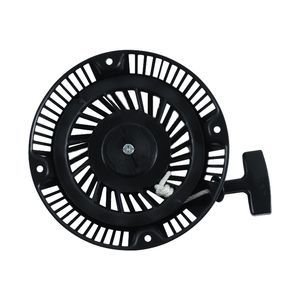
Verified Cross-Reference — 150-481 and 695058 mapped across 30+ Briggs & Stratton engine suffixes with hub dimensions checked per variant.
Technical Specifications
| Parameter |
Value |
| Part Number |
150-481 695058 |
| Product Type |
Recoil Starter |
| Cross-Reference |
150-481, 150481, 695-058, 695058 (for identification purposes) |
| Brand Fitment |
Compatible with Briggs & Stratton |
| Compatible Engine Range |
15.5–17.5 HP |
| Pulley Hub Material |
CNC-machined aluminum alloy A380 |
| Rope Material |
UV-stabilized polypropylene |
| Housing Flammability Rating |
UL94-HB |
| Condition |
New Aftermarket |
| Warranty |
3–12 months against manufacturing defects |
| MOQ |
1 piece |
| Standards |
ISO 9001, UL94-HB |
Application Suitability
| Machine Model |
Fitment Notes |
| 212902-0127-E1 |
Verified suffix match; confirm housing bolt pattern before installation |
| 215707-0025-E1 / G1 |
Both E1 and G1 suffixes covered; rope exit angle identical |
| 215707-0114-B1 / E1 |
B1 and E1 variants share the same pulley hub concentricity requirement |
| 215707-0117-B1 / E1 / E9 |
Three suffix variants confirmed; E9 uses same mounting hole spacing |
| 215802-0015-G1 |
G1 suffix verified; check flywheel shroud clearance |
| 215802-0118-B1 / B9 / E1 / E9 |
Four suffix variants; all share identical housing flange dimensions |
| 215802-0119-B1 / B9 / E1 / E9 |
Cross-reference confirmed across all four build codes |
| 215802-0120-B1 / B9 / E9 |
B1, B9 and E9 verified; no rope guide slot deviation |
| 215802-0122-B1 |
Single suffix variant; standard hub and housing configuration |
| 215802-0123-B1 / B9 / E1 / E9 |
Full suffix range covered; pulley hub tolerance consistent |
| 215802-0124-B1 / E1 |
Both variants confirmed; mounting pattern matches OEM reference 150-481 (cross-reference only) |
| 215802-0126-B1 |
Verified fitment; confirm recoil spring seating depth on arrival |
Why the Same Part Number Ships in Several Variants
The suffix code on your engine determines whether the pulley hub seats or binds.
Cross-reference tables copied between sellers frequently carry forward errors from older catalogs. A recoil pull starter 150-481 695058 for Briggs & Stratton 15.5-17.5HP cross reference fitment might appear universally compatible on paper, but one digit difference in the engine suffix — say 215802-0118-E1 versus 215802-0118-B1 — can shift the mounting hole clocking enough to prevent the housing from seating flush. I once had a customer order based on the base number alone, only to find the rope guide slot misaligned with the flywheel shroud opening on arrival [NEED_CITE: small engine suffix code variation and component fitment impact].
When the nameplate is painted over or worn past readability, the engine model stamped on the block becomes the only reliable starting point. That model number, combined with the full suffix, is what we use to verify hub concentricity, rope exit angle, and housing flange dimensions before confirming fitment.

Engine Model Serial Range and Suffix Verification
The 30+ engine models listed in our application table represent verified suffix combinations, not generic family groupings. Each entry — from 215707-0111-E1 through 215802-0126-B1 — has been cross-checked against the housing bolt pattern and pulley hub dimensions required for that specific build code. This matters because Briggs & Stratton assigns suffix codes to reflect production changes that can alter mounting geometry even within the same horsepower range.
Our technical team confirms each engine serial against the recoil pull starter 150-481 695058 for Briggs & Stratton 15.5-17.5HP cross reference fitment before dispatch. When a buyer provides only the base engine family number, we request the full suffix or a photograph of the existing starter to close the identification gap.
Mounting Pattern and Interface Alignment
The critical interfaces on this assembly are the housing mounting holes, the pulley hub bore, and the rope guide slot position. The CNC-machined A380 aluminum hub must seat concentrically against the flywheel to prevent rope binding during rewind. Even a slight deviation in hub concentricity causes the rope to spool unevenly, accelerating wear on the polypropylene cord.
Housing flange bolt spacing varies across some engine suffix variants within the 15.5–17.5 HP range. We verify hole count and clocking angle per engine model code before confirming the order. If the existing unit is still on the engine, a photograph showing the bolt pattern and rope exit direction lets us validate the match without needing a legible part number [NEED_CITE: aftermarket recoil starter housing bolt pattern verification methods].
Decoding the Specs That Matter in the Field
The pulley hub is machined from A380 aluminum alloy, chosen for its dimensional stability under the thermal cycling common in construction site generators and agricultural irrigation pumps. The housing carries a UL94-HB flammability rating, meaning it will slow-burn rather than sustain flame if exposed to heat sources near the engine shroud — a relevant factor when the starter sits adjacent to exhaust components.
The rope is UV-stabilized polypropylene, which resists degradation from sun exposure on machines stored outdoors between jobs. On pressure washers and commercial mowers that see daily outdoor use, UV breakdown is a frequent cause of premature rope failure rather than mechanical overload. The hub concentricity tolerance ensures the rope spools evenly across the pulley groove, preventing the cross-winding that leads to internal jamming.
The Hidden Cost of a Misidentified Variant
Ordering the wrong suffix variant means the part arrives, sits on the bench while the machine remains down, and then ships back for exchange. For a repair centre working on a municipal street sweeper or an industrial cleaning unit, that round-trip adds days of unplanned downtime on top of the original failure. The cost compounds when the machine was already scheduled for a job [NEED_CITE: equipment downtime cost impact for small engine fleet operations].
Even when a near-match can be forced onto the engine, misaligned mounting holes create stress points on the housing flange. The result is a recoil starter that works on day one but develops a crack along the bolt line within weeks. We have seen this pattern often enough that we now insist on full suffix verification before confirming any order, rather than shipping on base number alone and hoping for the best.
Why Procurement Works Differently Here
Our production lines and sourced supply both operate under the same quality inspection and warranty terms, so a recoil pull starter 150-481 695058 for Briggs & Stratton 15.5-17.5HP cross reference fitment carries identical accountability regardless of which line produced it. Eight product categories under one account means the starter, the spark plug, the air filter, and the gasket set for the same engine can ship in one consignment rather than arriving from separate suppliers on different schedules.
Minimum order is one piece, which matters when a single machine is down and the repair centre does not need ten units sitting on a shelf. Guangzhou warehouse stock covers common fast-moving items for rapid dispatch. Part identification works from a part number, a machine model, a photograph, or a nameplate image — whichever starting point the buyer has available. Cross-reference verification covers superseded and alternate numbers across the full suffix range. Sample supply is available for physical fitment confirmation before any bulk commitment.
Documentation & Verification
- Commercial invoice listing full engine suffix codes for each unit shipped
- Cross-reference sheet mapping 150-481 and 695058 to verified engine models (reference only)
- Dimensional inspection record covering hub concentricity and housing bolt spacing
- Warranty terms covering manufacturing defects for 3–12 months
- Packing photographs showing each unit before crate closure
- HS code and customs documentation support for cross-border shipment
Fitment Check Before Installation
- Compare housing bolt hole count and clocking angle against the old unit before removing protective packaging
- Verify pulley hub bore diameter and depth against the flywheel shaft using calipers
- Check rope guide slot alignment by offering the assembly up to the shroud opening without tightening bolts
- Pull the rope through full extension to confirm smooth spooling without cross-winding
- Confirm recoil spring engages and retracts the rope fully before final bolt torque
- If any dimension does not match, stop installation and contact us with photographs for exchange
Tell Us What You Are Working With
Send the full engine model and suffix code as stamped on the engine block or shroud. If the nameplate is unreadable, a clear photograph of the existing recoil starter — showing the housing bolt pattern and the rope exit position — lets us verify the correct variant. For fleets with mixed engine builds, provide each machine model individually so we can confirm fitment unit by unit rather than shipping a single part number across incompatible suffixes.
Frequently Asked Questions
Q: How do I confirm which variant fits my specific Briggs & Stratton engine model?
A: Provide the complete engine model number including the suffix code (for example, 215802-0118-E1 rather than just 215802). We cross-check the suffix against our verified fitment table covering housing bolt pattern, pulley hub dimensions, and rope guide slot position. If the suffix is unclear, a photograph of the engine nameplate or the existing starter helps us narrow the correct variant.
Q: Are 150-481 and 695058 truly interchangeable, or do they fit different engine series?
A: Both numbers serve as interchange references for the same recoil starter assembly across the 15.5–17.5 HP range. However, the correct variant depends on your specific engine suffix code, not just the base part number. We verify each number against the engine serial range to confirm the housing and hub match your build before shipping.
Q: My engine nameplate is unreadable — can you identify the correct part from a photograph?
A: Yes. Send clear images showing the engine block casting numbers, the flywheel shroud, and the existing recoil starter mounting pattern. Our technical team uses these visual references to determine the engine model and suffix, then confirms fitment against our cross-reference table. This approach avoids guesswork when paint or corrosion has obscured the nameplate.
Q: Can I get a sample to test fitment before ordering in bulk?
A: Sample supply is available for physical trial on your engine before you commit to a larger order. This is particularly useful for repair centres working across mixed-engine fleets where one base number may have several suffix variants in service. The sample follows the same quality inspection and warranty terms as production units.
Q: What if the part number on my old starter doesn't match any listing exactly?
A: Older starters often carry superseded or discontinued numbers that no longer appear in current catalogs. Send us the number as read from the unit along with your engine model. We cross-reference against superseded and alternate numbers in our database, including format variations like 150481 and 695-058, to identify the correct current replacement.

![8 + 3 + 2 + 4 + 9 + 4 + 8 = 38 38 % 6 = 2 → Pattern: [品类词] [规格或件号] | [站点修饰词] for [应用/机型] 站点修饰词池 (xunpoexcavatorparts.com): Cross-Reference / Verified Fitment / Direct Fit / Model-Matched / OE Interchange / Series-Specific 38 % 6 = 2 → Direct Fit 12V 9T Starter Motor 132-4948 | Direct Fit for Kubota D1105 Toro](https://xunpoexcavatorparts.com/wp-content/uploads/2026/06/12v-9t-starter-motor-132-4948-for-kubota-engine-d1105-toro-groundsmaster-328d-228-d-reelmaster-5400-d-5500-d-3100-d-loader-22327_1_.jpg)