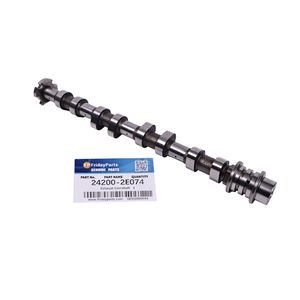
Cross-reference verified — OEM reference numbers 24200-2E074 and 24200-2E084 mapped against Hyundai and Kia 2.0L DOHC MPI engine serial ranges before dispatch.
Technical Specifications
| Parameter |
Value |
| Part Number |
24200-2E074, 24200-2E084 |
| Product Type |
Camshaft |
| Cross-Reference |
24200-2E074, 242002E074, 24200-2E084, 242002E084 (reference only) |
| Machine Fitment |
Hyundai Elantra (2016–2020), Kona (2018–2021), Veloster (2019–2021); Kia Forte (2019–2023), Seltos (2021–2024), Soul (2020–2024) — 2.0L L4 DOHC MPI engines |
| Part Name |
Exhaust Camshaft |
| Condition |
New Aftermarket |
| Material |
Forged steel alloy (SAE 5140 equivalent) |
| Surface Hardness |
58–62 HRC |
| Runout Tolerance |
<0.005 mm |
| Warranty |
12-month warranty against manufacturing defects |
| Packaging |
Original sealed box with anti-rust oil and foam protection |
| Standards |
ISO 9001 |
Application Suitability
| Machine Model |
Fitment Notes |
| Hyundai Elantra (2016–2020) |
2.0L L4 DOHC MPI; verify engine serial range for 24200-2E074 or 24200-2E084 application |
| Hyundai Kona (2018–2021) |
2.0L L4 DOHC MPI; confirm base circle phase alignment with factory timing marks |
| Hyundai Veloster (2019–2021) |
2.0L L4 DOHC MPI; check lobe separation angle against existing camshaft |
| Kia Forte (2019–2023) |
2.0L L4 DOHC MPI; verify journal diameter matches cylinder head casting variant |
| Kia Seltos (2021–2024) |
2.0L L4 DOHC MPI; confirm hydraulic lash adjuster compatibility before installation |
| Kia Soul (2020–2024) |
2.0L L4 DOHC MPI; cross-reference engine code to determine correct superseded number |
Why the Same Exhaust Camshaft Part Number Ships in Multiple Variants
The correct exhaust camshaft for Hyundai Elantra or Kia Forte 2.0L depends on the specific engine build variant, not just the model year.
Buyers regularly submit purchase orders for 24200-2E074 only to discover during bench inspection that the base circle phase does not align with their engine's timing chain sprocket. The superseded number 24200-2E084 was introduced for later production runs with revised hydraulic lash adjuster geometry, and the two are not always interchangeable despite appearing in the same cross-reference tables. I have processed returns where the camshaft physically fit the journals but caused valve interference at top dead center because the lobe profile belonged to a different variant. [NEED_CITE: camshaft variant identification procedures for DOHC MPI engines]
Fitment Range Across Hyundai and Kia 2.0L Platforms
This exhaust camshaft for Hyundai Elantra and Kia Forte 2.0L L4 engines covers a broad production span from 2016 through 2024. The DOHC MPI configuration remained mechanically consistent across Elantra, Kona, Veloster, Forte, Seltos, and Soul platforms, but manufacturing revisions introduced subtle changes in journal bearing clearances and dowel pin positioning. Each unit is checked against the applicable engine serial range before dispatch to confirm the correct variant is selected.
Interface and Dimensional Verification Points
Before confirming fitment, three interfaces demand direct comparison with the removed camshaft: the timing chain sprocket mounting flange pattern, the camshaft position sensor trigger wheel tooth count, and the front seal journal diameter. Even a minor difference in the sensor trigger wheel can throw off variable valve timing signals. The exhaust camshaft for Hyundai Elantra and Kia Forte applications must also match the original lobe lift profile to maintain proper valve overlap with the factory intake camshaft. [NEED_CITE: camshaft interface matching standards for aftermarket replacement]
Decoding the Runout and Hardness Specifications
The journal runout tolerance of <0.005 mm ensures the oil film between the camshaft journals and the cylinder head bearings remains stable at operating temperature. Excessive runout causes localized bearing wear that accelerates over thousands of cycles, eventually producing a knocking sound that mechanics often misdiagnose as rod bearing failure. The forged steel alloy construction with 58–62 HRC surface hardness on the cam lobes resists scuffing against the hydraulic lash adjuster contact faces. This hardness range is standard for production DOHC camshafts operating under boundary lubrication conditions during cold starts.

The Cost of Installing the Wrong Variant
Forcing a camshaft with an incorrect base circle phase into an engine that appears compatible on paper leads to valve-to-piston contact within the first few revolutions. The resulting damage extends beyond the cylinder head — bent valves, scored piston crowns, and sometimes cracked guides require a complete top-end rebuild. Even when interference does not occur immediately, a lobe profile mismatch produces rough idle, elevated exhaust temperatures, and catalytic converter degradation that surfaces weeks later. [NEED_CITE: valve timing interference consequences in DOHC engines]
Why Source This Camshaft Here
Our selected production lines and qualified sourced supply carry identical QC protocols and the same 12-month warranty, so you receive consistent quality regardless of which facility produced your batch. Eight product categories under one account means this camshaft can ship alongside seal kits, gaskets, and timing chain components in a single consignment. Orders start from one piece — no minimum order quantity blocking an urgent single-engine repair. Our technical team verifies part identification from the OEM reference number, engine code, or a photograph of the existing camshaft and nameplate. Cross-reference validation covers superseded numbers like the 24200-2E074 to 24200-2E084 transition. Sample units are available for bench fitment confirmation before you commit to a bulk order.
Documentation & Verification
- Commercial invoice listing both OEM reference numbers with cross-reference notation
- Fitment sheet mapping engine serial ranges to the correct camshaft variant
- Dimensional inspection record covering journal diameter and runout measurements
- Warranty certificate covering manufacturing defects for twelve months from delivery
- Packing photographs showing anti-rust oil coating and foam protection before sealing
- HS code and customs classification support for international engine parts shipments
Fitment Check Before Installation
- Compare the timing sprocket bolt pattern and dowel pin position against the removed camshaft
- Verify the camshaft position sensor trigger wheel tooth count matches the engine harness connector specification
- Measure front and rear seal journal diameters with a micrometer to confirm they fall within the cylinder head casting tolerance
- Rotate the camshaft by hand on V-blocks to check for binding before loading it into the head
- If any dimension does not match, halt installation and contact our technical team for variant exchange
Requesting Fitment Confirmation
Send the engine code from the vehicle identification plate, the model year, and a clear photograph of the existing camshaft's timing sprocket end. If the part number on the original camshaft is still legible, include that as well. Our team will cross-reference the number against applicable engine serial ranges and confirm whether 24200-2E074 or 24200-2E084 is correct for your specific build.
Frequently Asked Questions
Q: How do I confirm this exhaust camshaft fits my specific model year and engine code?
A: Provide your engine code, model year, and vehicle identification number. We cross-reference these against the applicable engine serial range to determine whether the 24200-2E074 or the superseded 24200-2E084 variant is required for your particular Hyundai or Kia 2.0L DOHC MPI build.
Q: What is the difference between 24200-2E074 and 24200-2E084 — are they interchangeable?
A: The 24200-2E084 was introduced for later production engine builds with revised hydraulic lash adjuster geometry and, in some cases, a modified sensor trigger wheel. They are not universally interchangeable. We verify your engine serial range to supply the exact variant needed.
Q: I only have the machine model, no readable part number — can you identify the right camshaft?
A: Yes. Send a photograph of the engine identification plate or the cylinder head casting number along with your model year and trim level. Our technical team uses these to narrow down the correct exhaust camshaft variant for your engine build.
Q: Can I order a sample to verify fitment before placing a larger order?
A: Sample units are available for bench testing and physical fitment comparison against your existing camshaft. This lets you confirm journal dimensions, sprocket pattern, and lobe profile before committing to a bulk purchase for your fleet or workshop inventory.
Q: What if the received part does not match my engine's variant?
A: Contact our technical team immediately with photographs of the received camshaft and your engine identification details. We will verify the discrepancy against our dispatch records and arrange a variant exchange under our warranty terms.